


If you are hunting for the best bedtime drink to help you wind down, you have probably already tried the classics. Chamomile tea. Warm milk. A mug of hot chocolate on the couch. They are comforting, and comfort counts for something. But most of them are warm liquid and not much else. A nighttime drink can do more than fill a mug, and the difference comes down to what is actually dissolved in it.
Here is a straight look at why an evening drink helps at all, what separates a real wind-down drink from a warm placebo, and where a melatonin-free mushroom cocoa fits into the picture.
Why a Warm Drink Before Bed Actually Does Something
Two things are happening when you drink something warm at night, and only one of them is psychological.
The first is the ritual. A repeated cue that always precedes bed helps your brain register sleep as the next step rather than a surprise. That is standard sleep hygiene, and it works better when the cue is consistent than when it is elaborate.
The second is temperature. Sleep onset involves a drop in core body temperature, and warming the body slightly before bed can accelerate that drop by pushing blood toward the skin, where heat escapes. A meta-analysis of 13 studies on before-bed warm baths and showers found that passive body heating 1 to 2 hours before bedtime was associated with better self-rated sleep quality, improved sleep efficiency, and shorter time to fall asleep [1]. A mug is not a bath, but the underlying mechanism is the same one glycine appears to use, which we will come back to.
What to Look For in a Bedtime Drink
Most drinks marketed for sleep fail on at least one of these. It is worth knowing which:
- Effectively no caffeine. This is non-negotiable and it is stricter than most people think. In a controlled study, 400 mg of caffeine taken 6 hours before bedtime still measurably disrupted sleep compared to placebo [2]. An evening drink with any meaningful caffeine load is working against you.
- No sugar spike. A standard packet of hot chocolate can carry 15 to 20 grams of added sugar. That is a blood sugar swing at exactly the wrong hour.
- Actual calming actives, at real amounts. Warm liquid alone is a ritual, not an intervention. If a product wants credit for supporting sleep, it needs ingredients with human research behind them, present in amounts that resemble what was studied.
- Something you will keep drinking. The most researched formula in the world does nothing sitting in a cupboard. Taste is not a vanity metric here, it is the compliance metric.
The Usual Options, and Where They Fall Short

Chamomile tea is the default, and it is gentle and pleasant. The evidence is real but modest. A randomized trial in 60 older adults found that 400 mg of chamomile extract daily for 28 days improved Pittsburgh Sleep Quality Index scores compared to a control group, though the benefit faded after the participants stopped taking it [3]. Worth noting: a tea bag is not the same as a 400 mg extract capsule.
Warm milk is tradition more than pharmacology. The tryptophan content is often cited, but the amount in a glass of milk is far too small to move brain serotonin meaningfully on its own. What it does have going for it is the warmth and the routine, which is not nothing.
Regular hot chocolate gets the comfort right and the rest wrong. Added sugar late at night, and depending on the mix, enough caffeine and theobromine from the cocoa to be counterproductive for sensitive sleepers.
Where Mushroom Cocoa Fits
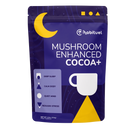
Our Enhanced Mushroom Cocoa + was built for this specific slot in the day. It delivers 3,600 mg of bioactives per cup, has 0 g of sugar, contains no added caffeine beyond the trace naturally present in cocoa, and, unlike most sleep products on the shelf, contains no melatonin at all. Here is what is doing the work.

Glycine
Glycine is an amino acid that has been studied specifically for pre-bedtime use. Research reviewed by the group that ran the original human trials reported that glycine taken before bed improved subjective sleep quality in people with insomniac tendencies, and that oral glycine lowered core body temperature by increasing blood flow to the skin [4]. That temperature drop is the same lever a warm bath pulls, which is a tidy piece of overlap for a warm nightly drink.
Magnesium glycinate
Magnesium reduces nervous system excitability and supports muscle relaxation, and it acts as a cofactor across the pathways involved in sleep regulation [5]. In a 2025 randomized, double-blind, placebo-controlled trial of 155 adults reporting poor sleep, magnesium bisglycinate produced a significantly greater reduction in Insomnia Severity Index scores than placebo over four weeks [6]. The honest caveat is that the effect size was small, and the researchers noted the biggest improvements appeared in people who started with lower dietary magnesium.
L-theanine
L-theanine is the amino acid from green tea associated with calm without sedation. In a four-week randomized, placebo-controlled crossover trial in 30 healthy adults, L-theanine improved Pittsburgh Sleep Quality Index scores, with specific improvements in sleep latency and sleep disturbance [7]. It is the ingredient aimed squarely at the racing-thoughts problem, where the body is tired but the mind will not stop narrating.
Reishi
Reishi is the only mushroom in this formula, and it is there because it is the calming one rather than an energy or focus mushroom. In a randomized, double-blind, placebo-controlled trial in 132 people, a reishi polysaccharide extract significantly reduced sense of fatigue and improved sense of well-being over 8 weeks compared with placebo [8]. A more recent randomized placebo-controlled trial of a mushroom blend reported improvements in sleep quality scores alongside reductions in cortisol [9], though because that trial used a blend, the result cannot be attributed to reishi alone.
Vitamin B6
Rather than dosing you with the sleep hormone directly, B6 supports the machinery that makes it. B vitamins act as essential cofactors in the synthesis of serotonin from tryptophan [10], and serotonin is the precursor your body converts into melatonin. It is a supporting role, not a substitute for the hormone itself.

How to Use It
- Make one warm cup roughly 30 to 60 minutes before you want to be asleep. That window gives the warmth time to do its temperature work and gives you time to actually settle.
- Dim the lights while you drink it. The cocoa is a cue, and cues work better stacked.
- Make it the last thing you consume. Sipping it during a doom-scroll session undercuts the point.
- Keep the timing consistent for about two weeks before you judge it. Sleep changes show up as a trend across nights, not as a single dramatic evening.
What to Realistically Expect
This is a supplement, not a sedative and not a sleeping pill. It will not knock you out, and it is not intended to diagnose, treat, cure, or prevent insomnia or any other condition. What most people are looking for from a nightly cup is more modest and more useful: a reliable signal that the day is over, a body that feels less wound up, and a morning that does not start in a fog. Individual results vary, and if you are pregnant, nursing, taking medication, or managing a sleep problem with a clinician, talk to your healthcare provider before adding any supplement.
The Bottom Line
The best bedtime drink is the one you will actually reach for every night, that does not fight your sleep with caffeine or sugar, and that contains something more than warmth. Chamomile and warm milk have the ritual half handled. A melatonin-free mushroom cocoa keeps the ritual and adds glycine, magnesium glycinate, L-theanine, reishi, and B6 to it, at 0 g of sugar.
Shop Enhanced Mushroom Cocoa +
If you want to go deeper, we broke down why we build a sleep formula without melatonin, and took an honest look at whether mushroom cocoa actually helps you sleep.
Frequently Asked Questions:
What can I drink to help me sleep?
The most useful nighttime drinks are warm, free of caffeine and added sugar, and contain ingredients with human research behind them. Chamomile tea has modest supporting evidence [3]. A melatonin-free mushroom cocoa adds glycine, magnesium glycinate, L-theanine, reishi, and vitamin B6 to the same warm ritual.
Is mushroom cocoa caffeine-free?
There is no added caffeine in Enhanced Mushroom Cocoa +. Cocoa naturally contains a trace amount, far less than a cup of coffee, so it is best described as virtually caffeine-free rather than absolutely zero.
Does mushroom cocoa have melatonin?
Ours does not. Enhanced Mushroom Cocoa + is completely melatonin-free. It includes vitamin B6 to support your body's own production pathway instead of supplying the hormone [10].
How long before bed should I drink it?
About 30 to 60 minutes before you want to be asleep. Research on before-bed warming found the effect strongest when it happened 1 to 2 hours ahead of bedtime [1], so anywhere in that range is reasonable.
Will it make me groggy in the morning?
It is not a sedative, so it is not designed to. It contains no melatonin, which is the ingredient most often blamed for next-day grogginess. Individual responses vary.
References
- Haghayegh S, Khoshnevis S, Smolensky MH, Diller KR, Castriotta RJ. Before-bedtime passive body heating by warm shower or bath to improve sleep: A systematic review and meta-analysis. Sleep Med Rev. 2019;46:124-135. doi:10.1016/j.smrv.2019.04.008
- Drake C, Roehrs T, Shambroom J, Roth T. Caffeine effects on sleep taken 0, 3, or 6 hours before going to bed. J Clin Sleep Med. 2013;9(11):1195-1200. doi:10.5664/jcsm.3170
- Adib-Hajbaghery M, Mousavi SN. The effects of chamomile extract on sleep quality among elderly people: A clinical trial. Complement Ther Med. 2017;35:109-114. doi:10.1016/j.ctim.2017.09.010
- Bannai M, Kawai N. New therapeutic strategy for amino acid medicine: glycine improves the quality of sleep. J Pharmacol Sci. 2012;118(2):145-148. doi:10.1254/jphs.11R04FM
- He C, Wang B, Chen X, Xu J, Yang Y, Yuan M. The Mechanisms of Magnesium in Sleep Disorders. Nat Sci Sleep. 2025;17:2639-2656. doi:10.2147/NSS.S552646
- Schuster J, Cycelskij I, Lopresti A, Hahn A. Magnesium Bisglycinate Supplementation in Healthy Adults Reporting Poor Sleep: A Randomized, Placebo-Controlled Trial. Nat Sci Sleep. 2025;17:2027-2040. doi:10.2147/NSS.S524348
- Hidese S, Ogawa S, Ota M, et al. Effects of L-Theanine Administration on Stress-Related Symptoms and Cognitive Functions in Healthy Adults: A Randomized Controlled Trial. Nutrients. 2019;11(10):2362. doi:10.3390/nu11102362
- Tang W, Gao Y, Chen G, et al. A randomized, double-blind and placebo-controlled study of a Ganoderma lucidum polysaccharide extract in neurasthenia. J Med Food. 2005;8(1):53-58. doi:10.1089/jmf.2005.8.53
- Hisamuddin AS, Ramli F, Leo TK, et al. Adaptogenic Effects of Mushroom Blend Supplementation on Stress, Fatigue, and Sleep: A Randomised, Double-Blind, and Placebo-Controlled Trial. Brain Behav. 2026;16(1):e71193. doi:10.1002/brb3.71193
- Tang J, Krushelnycky L, Shaqo A, Cho CE. A Comprehensive Review of Nutritional Influences on the Serotonergic System. Adv Nutr. 2025;16(11):100524. doi:10.1016/j.advnut.2025.100524
These statements have not been evaluated by the Food and Drug Administration. This product is not intended to diagnose, treat, cure, or prevent any disease.