
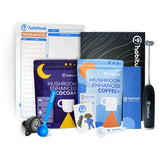
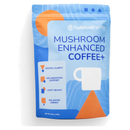
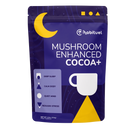


"Mushroom cocoa for sleep" sounds like two wellness trends taped together. If your first reaction was skepticism, that is the correct instinct, and it is the one we would rather you bring. So let us take the question seriously: does mushroom cocoa actually help you sleep, or is it hot chocolate with a story attached?
The answer depends almost entirely on what is in the specific tin, and most of the category does not survive that question. Here is how to tell the difference, what the research on each ingredient in our formula actually shows, and what it will not do.
The Real Problem With This Category
Most functional drinks fail in the same way. They contain a recognizable ingredient list at amounts small enough to be decorative. A pinch of mushroom powder printed on the front, buried inside a proprietary blend so you cannot tell how much of anything you are getting.
The test that separates a real formula from a marketing one is simple to state and awkward for most brands to answer:
- Is the amount disclosed? A proprietary blend that lists five ingredients and one total number is hiding the ratio for a reason.
- Does the amount resemble what was studied? Trials of these actives use gram-scale and hundred-milligram-scale doses, not trace amounts.
- Do the ingredients agree with each other? A sleep product containing lion's mane or cordyceps is not a sleep product. Those are the energy and focus mushrooms.
- Is the evidence human? A great deal of mushroom research is cell culture and rodent work. That is legitimate science and it is not the same as a human outcome.
Enhanced Mushroom Cocoa + delivers 3,600 mg of bioactives per cup, with 0 g of sugar, no melatonin, and reishi as the only mushroom. Now the harder part: what does the research on each of those actually support?

Going Ingredient by Ingredient
Glycine: the strongest card in the deck
Glycine has the most directly relevant evidence of anything in the formula, because it was studied for precisely this use. A review by the research group that ran the original human trials reported that glycine ingested before bedtime improved subjective sleep quality in people with insomniac tendencies, and that oral glycine lowered core body temperature by increasing blood flow to the skin [1]. Falling asleep involves core temperature dropping, so the mechanism is plausible and not merely correlational.
The caveat: the human outcomes here are subjective sleep quality measures, and the sample sizes in this line of work are small.
Magnesium glycinate: real, and modest
Magnesium reduces nervous system excitability and supports muscle relaxation, and it functions as a cofactor across sleep-regulating pathways [2]. The best recent evidence is a 2025 randomized, double-blind, placebo-controlled trial in 155 adults with self-reported poor sleep, which found magnesium bisglycinate reduced Insomnia Severity Index scores significantly more than placebo over four weeks [3].
The caveat, stated plainly by the researchers: the effect size was small (Cohen's d = 0.2), and the clearest responders were people who started with low dietary magnesium. If your magnesium intake is already good, expect less.
L-theanine: good evidence, for the right problem
In a four-week randomized, placebo-controlled crossover trial in 30 healthy adults, L-theanine improved Pittsburgh Sleep Quality Index scores, specifically sleep latency and sleep disturbance, along with lower anxiety and depression scale scores [4]. It works on the mind-will-not-settle problem rather than by sedating you.
The caveat: that trial used 200 mg per day. Our cup contains 150 mg, which is in the same range but not identical, and 30 participants is a small study.
Reishi: promising, not proven
Reishi is the calming mushroom in traditional use, and it is the only mushroom here because the others would contradict the purpose. The human evidence is real but thinner than the marketing across this whole industry suggests. A randomized, double-blind, placebo-controlled trial in 132 people found a reishi polysaccharide extract significantly improved sense of fatigue and sense of well-being over 8 weeks compared to placebo [5]. A 2026 randomized placebo-controlled trial of a mushroom blend reported improved sleep quality scores and reduced cortisol [6].
The caveats matter here. The 2005 trial measured fatigue and well-being, not sleep, and used a much larger daily amount than a single cup provides. The 2026 trial used a blend, so reishi's individual contribution cannot be separated out. Anyone telling you reishi is a proven sleep aid is ahead of the evidence.
Vitamin B6: a supporting part, not a lead
B vitamins act as essential cofactors in the synthesis of serotonin from tryptophan [7], and serotonin is what your body converts into melatonin. B6 is in the formula to support that pathway rather than to supply the hormone. It is a sensible inclusion and it is not the reason the drink works.
Dutched cocoa: flavor, and we will not oversell it
Cocoa is here because it makes a nightly habit pleasant enough to keep, and that genuinely matters for anything you are supposed to take every day. We will not claim it as an antioxidant benefit: research on commercial cocoa powders found that alkalization, the Dutch process that gives cocoa its smooth dark character, substantially reduces flavanol and total polyphenol content compared to natural cocoa [8]. Dutched cocoa tastes better in a hot drink and is gentler on the stomach. That is the reason it is in there.
What It Will Not Do
Setting expectations matters as much as listing benefits, so here it is without hedging in the wrong direction.
- It will not fix a broken sleep environment. If you are scrolling in bed at midnight in a warm bright room, no drink is going to out-argue that.
- It is not instant. The trials behind these ingredients ran four to eight weeks, not one night.

What Is Realistic
A calmer approach to bedtime. Less of the wired-but-tired feeling. A consistent cue that ends the day. And because there is no melatonin in it, no next-morning fog from the ingredient most associated with that complaint.
The Bottom Line
Does mushroom cocoa help you sleep? A cocoa mix with a dusting of mushroom powder will not. A formula built on glycine, magnesium glycinate, L-theanine, reishi, and B6, at 3,600 mg of bioactives with no sugar and no melatonin, is a reasonable and evidence-informed way to support winding down. The evidence for each piece ranges from solid to promising, and we would rather tell you which is which than flatten it into a headline.
Shop Enhanced Mushroom Cocoa +
More on this: the best bedtime drink to wind down and why we skip melatonin entirely.
Frequently Asked Questions:
Does mushroom cocoa really work for sleep?
It depends on the formula. Products with trace mushroom powder and added sugar have little to offer. A formula with dosed, evidence-informed actives such as glycine, magnesium glycinate, and L-theanine has human research behind each ingredient [1][3][4], with effect sizes that are real and modest rather than dramatic.
What is actually in mushroom cocoa?
Enhanced Mushroom Cocoa + contains glycine, reishi, magnesium glycinate, 150 mg of L-theanine, vitamin B6, and Dutched cocoa, totaling 3,600 mg of bioactives per cup with 0 g of sugar and no melatonin.
Is mushroom cocoa a sedative?
No. It contains no sedating drugs and is not designed to force sleep. The actives support relaxation and sleep quality rather than inducing unconsciousness.
How long until I notice a difference?
The clinical trials behind these ingredients ran four to eight weeks. Give it about two weeks of consistent nightly use before judging, and look for a trend across nights rather than a single result.
Is reishi good for sleep?
Reishi has a long traditional use as a calming tonic, and a randomized trial found a reishi extract improved fatigue and well-being scores over 8 weeks [5]. Direct human evidence for reishi specifically improving sleep is still limited, and we would rather say so than overstate it.
References
- Bannai M, Kawai N. New therapeutic strategy for amino acid medicine: glycine improves the quality of sleep. J Pharmacol Sci. 2012;118(2):145-148. doi:10.1254/jphs.11R04FM
- He C, Wang B, Chen X, Xu J, Yang Y, Yuan M. The Mechanisms of Magnesium in Sleep Disorders. Nat Sci Sleep. 2025;17:2639-2656. doi:10.2147/NSS.S552646
- Schuster J, Cycelskij I, Lopresti A, Hahn A. Magnesium Bisglycinate Supplementation in Healthy Adults Reporting Poor Sleep: A Randomized, Placebo-Controlled Trial. Nat Sci Sleep. 2025;17:2027-2040. doi:10.2147/NSS.S524348
- Hidese S, Ogawa S, Ota M, et al. Effects of L-Theanine Administration on Stress-Related Symptoms and Cognitive Functions in Healthy Adults: A Randomized Controlled Trial. Nutrients. 2019;11(10):2362. doi:10.3390/nu11102362
- Tang W, Gao Y, Chen G, et al. A randomized, double-blind and placebo-controlled study of a Ganoderma lucidum polysaccharide extract in neurasthenia. J Med Food. 2005;8(1):53-58. doi:10.1089/jmf.2005.8.53
- Hisamuddin AS, Ramli F, Leo TK, et al. Adaptogenic Effects of Mushroom Blend Supplementation on Stress, Fatigue, and Sleep: A Randomised, Double-Blind, and Placebo-Controlled Trial. Brain Behav. 2026;16(1):e71193. doi:10.1002/brb3.71193
- Tang J, Krushelnycky L, Shaqo A, Cho CE. A Comprehensive Review of Nutritional Influences on the Serotonergic System. Adv Nutr. 2025;16(11):100524. doi:10.1016/j.advnut.2025.100524
- Miller KB, Hurst WJ, Payne MJ, et al. Impact of alkalization on the antioxidant and flavanol content of commercial cocoa powders. J Agric Food Chem. 2008;56(18):8527-8533. doi:10.1021/jf801670p
These statements have not been evaluated by the Food and Drug Administration. This product is not intended to diagnose, treat, cure, or prevent any disease.