
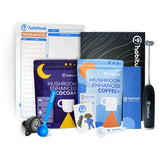


Melatonin is the default answer to "I can't sleep," and for a lot of people it is also the reason they went looking for something else. If you have ever woken up feeling thick-headed, had strange vivid dreams, or felt uneasy about taking a hormone every single night, you are the reason a melatonin-free sleep aid is worth talking about. There is a whole category of sleep-supporting ingredients that work on relaxation and sleep architecture rather than on dosing your body with the hormone it already makes.
Here is the case for the melatonin-free approach, and the specific actives we put in our Enhanced Mushroom Cocoa + instead.
What Melatonin Actually Does, and Where It Falls Short
Melatonin is not a sedative. It is a timing signal. Your pineal gland releases it as darkness falls, telling your body that the biological night has started. Taking it as a supplement mostly shifts or reinforces that signal.
It does work, and it is worth being precise about how much. A meta-analysis of 19 randomized placebo-controlled trials covering 1,683 people found melatonin significantly reduced the time it took to fall asleep, by an average of about 7 minutes, and increased total sleep time by about 8 minutes [1]. Those are real, statistically significant effects. They are also smaller than the marketing around melatonin tends to imply.
Two other things are worth knowing. First, typical retail doses are far higher than the amount your body produces, and higher doses are not reliably better. Second, because melatonin is a circadian signal rather than a relaxant, taking it does nothing for the two problems people most often actually have at bedtime: a body that is still tense and a mind that will not stop running.
None of that makes melatonin bad. It makes it a specific tool for a specific job, mostly circadian problems like jet lag and delayed sleep phase. For the ordinary "I am wound up and can't settle" night, it is aimed at the wrong target.

The Melatonin-Free Approach: Support the System, Don't Replace It
The alternative is to work on the conditions that let sleep happen. Lower the arousal, quiet the mental noise, ease the muscle tension, help core temperature fall, and give your body the raw materials to run its own melatonin production. That is a slower, less dramatic lever than dosing the hormone, and for a nightly habit it is a more sensible one.
These are the five actives we chose for that job.

Glycine: deep sleep without the hangover
Glycine is an amino acid with a genuinely interesting bedtime profile. Research from the group that ran the original human trials reported that glycine taken before bed improved subjective sleep quality in people with insomniac tendencies, and that oral glycine produced a measurable decrease in core body temperature by increasing blood flow to the skin [2]. Since sleep onset depends on core temperature falling, that mechanism lines up neatly with what a warm evening drink is already doing.
Magnesium glycinate: the tension release
Magnesium lowers nervous system excitability, supports muscle relaxation, and serves as a cofactor across circadian and energy-balance pathways [3]. In a 2025 randomized, double-blind, placebo-controlled trial of 155 adults with self-reported poor sleep, magnesium bisglycinate at 250 mg of elemental magnesium daily reduced Insomnia Severity Index scores significantly more than placebo across four weeks [4]. The researchers described the effect as modest, and noted the largest improvements in participants who started with lower dietary magnesium. We use the glycinate form because it is well absorbed and gentler on the stomach than magnesium oxide, and because the glycine half of the molecule is useful in its own right.
L-theanine: for the mind that will not stop
L-theanine is the amino acid in green tea associated with calm alertness. In a four-week randomized, placebo-controlled crossover trial in 30 healthy adults, L-theanine improved Pittsburgh Sleep Quality Index scores, with specific reductions in sleep latency and sleep disturbance, alongside lower anxiety scores [5]. It is not sedating, which is exactly the point. It targets the racing-thoughts problem rather than forcing unconsciousness.
Reishi: the evening adaptogen
Reishi is the calming mushroom, which is why it is the only mushroom in this formula. Putting lion's mane or cordyceps in a sleep product would work against the whole idea. In a randomized, double-blind, placebo-controlled trial in 132 people, a reishi polysaccharide extract significantly improved sense of fatigue and sense of well-being over 8 weeks compared to placebo [6]. A 2026 randomized placebo-controlled trial of a mushroom blend also reported improved sleep quality scores and reduced cortisol [7], though as a blend study it cannot isolate reishi's contribution. Reishi has a long traditional use as a calming tonic, and the modern human evidence is promising rather than definitive.
Vitamin B6: help your body make its own
This is the ingredient that most directly earns the melatonin-free label. Your body builds melatonin from serotonin, and serotonin from the amino acid tryptophan. B vitamins act as essential cofactors in that synthesis pathway [8]. Supporting the pathway is a different proposition from supplying the finished hormone, and for a product you drink every night, supporting is the design we wanted.
Why Cocoa Is the Delivery Vehicle
A sleep formula only works if you take it, and capsules are easy to forget. A warm drink is not. It occupies the same slot in the evening that tea or hot chocolate already occupies, which means there is no new habit to build, just a substitution.
Warmth also pulls its own weight. A meta-analysis of before-bed passive body heating found that warming the body 1 to 2 hours before bedtime was associated with improved sleep quality and shorter time to fall asleep, by way of helping core temperature drop [9]. And because ours has 0 g of sugar, the cup does not come with a late blood sugar swing attached.

Who This Suits
- People who react badly to melatonin. If grogginess, heavy dreams, or a hungover feeling is your experience, a formula without it is the obvious place to start.
- Anyone uneasy about nightly hormone use. A reasonable preference, and one you do not have to justify to anybody.
- People whose problem is winding down, not timing. If you are tense and mentally busy rather than jet-lagged, relaxation actives are aimed at your actual problem.
- Anyone who wants an evening ritual rather than a pill. The drink is half the value.
What to Expect
These are supplements, not medications, and they are not intended to diagnose, treat, cure, or prevent insomnia or any other condition. The realistic outcome is a calmer approach to bed, less time lying there with a busy mind, and a morning that starts clear. Give it about two weeks of consistent use before you form a verdict, because sleep effects show up as a trend rather than a single night. Individual results vary. If you are pregnant, nursing, or taking medication, particularly anything affecting sleep, mood, or blood pressure, talk to your healthcare provider first.
The Bottom Line
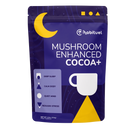
Melatonin is a timing signal with a modest, real effect and a specific job. If it does not suit you, or if your problem is arousal rather than timing, there is a well-supported alternative: glycine, magnesium glycinate, L-theanine, reishi, and vitamin B6, delivered in a warm cup with no sugar and no hormone. That is exactly what Enhanced Mushroom Cocoa + is, at 3,600 mg of bioactives per serving.
Shop Enhanced Mushroom Cocoa +
Related reading: the best bedtime drink to wind down and mushroom cocoa for menopause nights.
Frequently Asked Questions:
Is there a sleep aid without melatonin?
Yes. Ingredients such as glycine, magnesium glycinate, L-theanine, and reishi support relaxation and sleep quality without supplying the hormone. Enhanced Mushroom Cocoa + combines all four plus vitamin B6 and contains zero melatonin.
Why would someone avoid melatonin?
Common reasons include next-day grogginess, vivid dreams, and a preference not to take a hormone nightly. Melatonin also mainly addresses sleep timing rather than the wound-up feeling many people are actually dealing with at bedtime.
Does magnesium glycinate help you sleep?
A 2025 randomized placebo-controlled trial in 155 adults with poor sleep found magnesium bisglycinate reduced Insomnia Severity Index scores significantly more than placebo over four weeks, with a small effect size [4]. Magnesium also supports muscle relaxation and lowers nervous system excitability [3].
What does glycine do for sleep?
Human research reviewed by the original trial group reported that glycine before bed improved subjective sleep quality in people with insomniac tendencies, and that it lowered core body temperature, which is part of normal sleep onset [2].
Is mushroom cocoa a melatonin alternative?
It is a melatonin-free option built around relaxation and sleep-quality actives rather than hormone dosing. It is a dietary supplement, not a medication, and it is not intended to treat any sleep disorder.
References
- Ferracioli-Oda E, Qawasmi A, Bloch MH. Meta-analysis: melatonin for the treatment of primary sleep disorders. PLoS One. 2013;8(5):e63773. doi:10.1371/journal.pone.0063773
- Bannai M, Kawai N. New therapeutic strategy for amino acid medicine: glycine improves the quality of sleep. J Pharmacol Sci. 2012;118(2):145-148. doi:10.1254/jphs.11R04FM
- He C, Wang B, Chen X, Xu J, Yang Y, Yuan M. The Mechanisms of Magnesium in Sleep Disorders. Nat Sci Sleep. 2025;17:2639-2656. doi:10.2147/NSS.S552646
- Schuster J, Cycelskij I, Lopresti A, Hahn A. Magnesium Bisglycinate Supplementation in Healthy Adults Reporting Poor Sleep: A Randomized, Placebo-Controlled Trial. Nat Sci Sleep. 2025;17:2027-2040. doi:10.2147/NSS.S524348
- Hidese S, Ogawa S, Ota M, et al. Effects of L-Theanine Administration on Stress-Related Symptoms and Cognitive Functions in Healthy Adults: A Randomized Controlled Trial. Nutrients. 2019;11(10):2362. doi:10.3390/nu11102362
- Tang W, Gao Y, Chen G, et al. A randomized, double-blind and placebo-controlled study of a Ganoderma lucidum polysaccharide extract in neurasthenia. J Med Food. 2005;8(1):53-58. doi:10.1089/jmf.2005.8.53
- Hisamuddin AS, Ramli F, Leo TK, et al. Adaptogenic Effects of Mushroom Blend Supplementation on Stress, Fatigue, and Sleep: A Randomised, Double-Blind, and Placebo-Controlled Trial. Brain Behav. 2026;16(1):e71193. doi:10.1002/brb3.71193
- Tang J, Krushelnycky L, Shaqo A, Cho CE. A Comprehensive Review of Nutritional Influences on the Serotonergic System. Adv Nutr. 2025;16(11):100524. doi:10.1016/j.advnut.2025.100524
- Haghayegh S, Khoshnevis S, Smolensky MH, Diller KR, Castriotta RJ. Before-bedtime passive body heating by warm shower or bath to improve sleep: A systematic review and meta-analysis. Sleep Med Rev. 2019;46:124-135. doi:10.1016/j.smrv.2019.04.008
These statements have not been evaluated by the Food and Drug Administration. This product is not intended to diagnose, treat, cure, or prevent any disease.