


L-Theanine is a naturally occurring amino acid found primarily in tea leaves and some types of mushrooms. It was first discovered in tea by Japanese scientists in 1949. Unlike other amino acids that are used to build proteins, L-Theanine has unique nootropic properties that act directly on the brain.
It is best known for what it does alongside caffeine. Caffeine increases alertness but also produces jitters, anxiety and an energy crash; L-Theanine counterbalances those effects, and the pair together outperform caffeine alone on measures of attention and focus[3][7][13]. Habituel includes L-Theanine in both Mushroom Enhanced Coffee+ and Cocoa+.
1 Description and habitat
L-Theanine is unusual among amino acids: it is not used to build proteins and it is not common in the typical diet. Its main natural source is the tea plant, which is why a cup of green tea produces a different quality of alertness than an equivalent dose of caffeine on its own. Structurally it resembles glutamate closely enough to cross the blood-brain barrier and interact with glutamate receptors, which is the basis of its effect on the brain[8].
2 How it works
L-Theanine works by influencing brain chemistry on two fronts. It reduces cortisol, the hormone behind the fight-or-flight response, which is why it measurably blunts the physiological stress response[1]. It also increases levels of serotonin and dopamine, the neurotransmitters that regulate mood, sleep, emotion and focus. The result is a state described consistently across the literature as relaxation without drowsiness: calm that does not cost alertness. That state has a measurable signature. In a randomised, triple-blind crossover trial, a single 200 mg dose raised alpha-wave power substantially and lowered salivary cortisol within an hour of intake[17].
3 Research
L-Theanine has one of the strongest human research trails of any ingredient in either formula, with multiple randomised, double-blind, placebo-controlled trials in healthy adults[1][6][7]. The sections below set out what each body of work established, with every source cited and linked.
3.1 Counterbalancing caffeine
Caffeine increases alertness and concentration, but it also produces jitters, anxiety, headaches and an energy crash once its effects wear off. L-Theanine mitigates those side effects, which makes the combination more effective for cognitive performance than caffeine alone[3][7]. The pairing reduces jitters and anxiety while improving attention and focus beyond what caffeine achieves on its own[7][13], and it prevents the crash by supporting a more sustained lift. A 2025 meta-analysis of the pairing found measurable gains in reaction time and attention in the second hour after intake, along with a benefit for mood[13]. In one trial the combination held up even under sleep deprivation: 200 mg of L-Theanine with 160 mg of caffeine produced faster reaction times and stronger attention-related brain signals in tired young adults[18]. Earlier work on the same pairing improved hit rate and target discrimination on an attention task[20].
3.2 Calm without drowsiness
L-Theanine increases the levels of calming chemicals in the brain, including serotonin and dopamine, which reduce stress and promote relaxation. Unlike most relaxation aids it does this without causing drowsiness, so alertness is preserved[2]. People taking L-Theanine feel less anxious and more relaxed during stressful situations, and the effect has been measured physiologically as well as by self-report[1]. A systematic review of nine randomised trials concluded that 200 to 400 mg a day may reduce stress and anxiety under stressful conditions[16], and a pooled analysis of tea constituents found moderate effects on both alertness and state anxiety[14]. A four-week trial at 200 mg a day lowered trait anxiety and depression scores and improved sleep quality and verbal fluency[15]. The receptor work underneath this shows theanine competing with glutamate at glutamate receptors in animal brain tissue[8].
3.3 Cognitive performance
L-Theanine improves brain function on several measures: alertness, attention, reaction time and memory[3][4]. The effect is consistent enough that students and professionals use it specifically for sustained focus. In controlled testing, people taking L-Theanine with caffeine performed better on cognitive tests and reported feeling more alert than those who did not[3]. A meta-analysis of 31 randomised trials found that a single 200 mg dose improved choice reaction time and reduced depressive symptoms[11]. Attentional switching accuracy improves too, which is the measure closest to what a working morning actually demands: moving between tasks without losing the thread[14]. Nor is this only a caffeine story. L-Theanine on its own improved neurophysiological measures of attention dose-dependently in a double-blind crossover trial[19], and a review of the caffeine pairing reports faster reactions, less mind-wandering and better inhibitory control[21].
3.4 Other areas under study
L-Theanine has also been studied for sleep quality, where it improved objectively measured sleep in a randomised, double-blind, placebo-controlled trial[5], and that single trial is no longer the whole picture: a 2025 meta-analysis pooling 19 studies and 897 participants found significant improvements in how quickly people fell asleep, in daytime function and in overall sleep quality[12]. It has also been studied for stress reduction measured by magnetoencephalography in a crossover trial[6]. Further work examines its effect on blood pressure and the sympathetic nervous system[9] and on immune cell activity. Each of these areas has its own published literature, linked in full in the references section below.
4 Strength of the evidence
Not all evidence carries the same weight. This is what the research behind L-Theanine rests on.
- Multiple randomised, double-blind, placebo-controlled trials in healthy adults, which is the strongest study design available for this kind of question.
- The caffeine pairing has been replicated independently by separate research groups across more than a decade.
- Effects have been measured objectively, including heart rate, salivary markers, polysomnography and magnetoencephalography, not only by self-report.
- The mechanism is characterised at the receptor level, so the observed effects have a documented physiological explanation.
- The findings have been pooled by independent meta-analyses, including one covering 31 randomised trials and another covering 19 sleep studies, rather than resting on single trials.
5 Safety and interactions
L-Theanine has a strong safety record and is well tolerated at the amounts used in research, but a few considerations apply.
6 Sourcing, extraction and quality
L-Theanine is an isolated compound, so the questions to ask are about form and quantity rather than which part of a plant was used. The terms below are the ones worth checking on any label.
7 Use in Habituel formulas
Habituel uses L-Theanine in both formulas: in Mushroom Enhanced Coffee+ it is paired with a lower caffeine load to deliver focus without the jitters, and in Cocoa+ it supports the evening wind-down. It is included at the level used in the research described above rather than a token amount added for the label. Exact quantities per serving are proprietary. Every ingredient is listed separately, so there is no proprietary blend hiding the ratio.
8 References
Last reviewed August 2026 · 21 references cited. This article is for information only. These statements have not been evaluated by the Food and Drug Administration. This product is not intended to diagnose, treat, cure, or prevent any disease.
9 See also
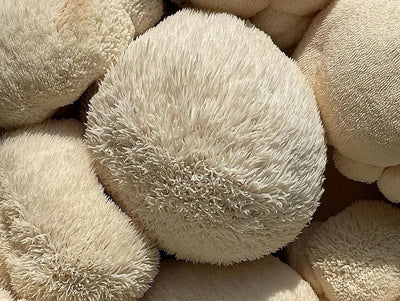 Lion's Mane
Focus and memory
Lion's Mane
Focus and memory
 Chaga
Antioxidant density
Chaga
Antioxidant density
 Turkey Tail
Immune and gut support
Turkey Tail
Immune and gut support
 Collagen Peptides
Joints, skin, recovery
Collagen Peptides
Joints, skin, recovery
 Arabica Coffee
The morning base
Arabica Coffee
The morning base
 Reishi
Wind-down and calm
Reishi
Wind-down and calm
 Glycine
Deeper sleep
Glycine
Deeper sleep
 Magnesium Glycinate
Physical tension
Magnesium Glycinate
Physical tension
 Vitamin B6
Your own melatonin pathway
Vitamin B6
Your own melatonin pathway
 Dutched Cocoa
The night ritual
Dutched Cocoa
The night ritual